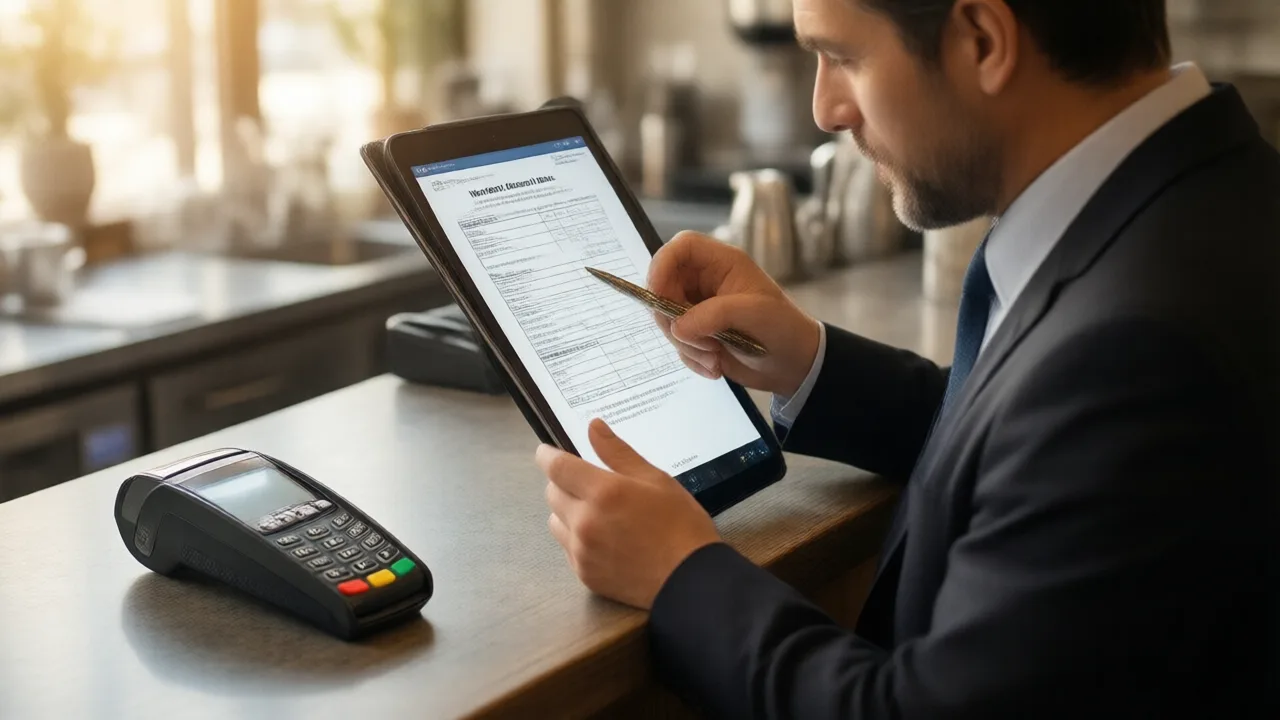
You swipe a guest's card, the terminal beeps "approved," and two days later a deposit lands in your checking account for a little less than the sale. Somewhere in that gap sits a merchant account, quietly doing the work — and almost every restaurant owner signs up for one without ever being told what it actually is. That gap is where funding delays, surprise holds, and mystery deductions come from, so it's worth understanding the thing on its own terms.
Let's define it cleanly, separate it from the two things it's constantly confused with, price it out for a real restaurant, and cover the restaurant-specific traps — holds, reserves, and tip adjustments — that a general small-business guide will never warn you about.
The Plain Definition
A merchant account is a type of bank account that authorizes a business to accept and hold card payments. It is not where your money ends up. It is where your money waits. When a guest pays with a card, the funds are authorized, captured, and routed into your merchant account, then batched and settled into your everyday business checking account — usually within one to two business days.
Think of it as a holding tank with rules. The card networks and the bank that issues the merchant account (the "acquiring bank") need somewhere to place funds while a transaction clears, while chargebacks can still be filed, and while the system verifies you are who you say you are. The merchant account is that somewhere. No merchant account, no ability to accept Visa, Mastercard, Discover, or Amex at all.
Merchant Account vs. Payment Gateway vs. Processor
Here's the confusion that costs restaurants money: these three terms get used interchangeably by salespeople, and they are not the same thing. You need all three to take a card, and each does a distinct job.
| Component | What it does | Restaurant example |
|---|---|---|
| Payment gateway | Securely transmits card data from the point of sale to the processor | The software layer inside your terminal or online ordering checkout |
| Payment processor | Moves the transaction between the card networks and the banks, and handles authorization and settlement | The company on your merchant statement doing the "processing" |
| Merchant account | Holds the funds after capture and before deposit; carries the underwriting and liability | The account your daily card batches settle into |
The gateway is the messenger. The processor is the mover. The merchant account is the vault. In modern all-in-one payment platforms all three are bundled so tightly that you never see them separately — which is convenient, until something goes wrong and you can't tell which layer caused it. Knowing the difference is the first step to reading a merchant agreement instead of just signing it. If you want the full flow from tap to deposit, our restaurant payment processing guide maps every step in order.
Two Ways Restaurants Get One
There are really only two paths to a merchant account, and the choice shapes both your costs and your risk of getting shut off.
Aggregated (the instant-signup model)
The familiar all-in-one payment brands don't give you your own merchant account. They put you inside a giant shared "master" merchant account alongside millions of other businesses. That's why signup takes ten minutes with no underwriting call: you're a sub-account, not an account holder. The upside is speed and simplicity. The downside is control — because you share risk with everyone else in the pool, the provider can freeze deposits or offboard you quickly and with little explanation if their fraud model flags your activity, and restaurants with lumpy, seasonal, or high-average-ticket volume trip those models more than people expect.
Dedicated (your own account)
A dedicated merchant account, set up through an acquiring bank or an ISO (independent sales organization), is underwritten to your business specifically. It takes longer to open — days, sometimes with a real conversation about your volume and history — but you get a stable account with a defined risk profile, more predictable funding, and pricing you can actually negotiate. For an established restaurant doing meaningful volume, a dedicated account paired with transparent interchange-plus pricing is almost always the stronger long-term footing.
Rule of thumb: aggregated accounts optimize for how fast you can start. Dedicated accounts optimize for whether you'll still be running smoothly a year from now.
What a Merchant Account Actually Costs
The merchant account itself is rarely a single line item. Its cost is spread across the fees attached to accepting cards, and they stack in predictable ways. Here's the realistic picture for a card-present restaurant in 2026:
| Fee | Typical range | Notes |
|---|---|---|
| Processing (blended effective rate) | 2.2% – 2.9% | The big one; varies by pricing model and card mix |
| Monthly account/platform fee | $0 – $40 | Sometimes waived on aggregated accounts |
| PCI compliance fee | $5 – $20/month | Or an annual non-compliance penalty if you skip validation |
| Batch/settlement fee | $0 – $0.25/day | Charged each time you close out a day's transactions |
| Chargeback fee | $15 – $40 each | Charged whether you win the dispute or not |
| Monthly minimum | $0 – $35 | You pay it in a slow month even if fees fall short |
The single most useful number is your effective rate — total fees divided by total card volume for the month. A healthy card-present restaurant lands between 2.2% and 2.6%. Anything above 2.9% means something in the stack is bleeding, and it's worth running your real numbers through a restaurant processing fee calculator before you renew anything. For a deeper teardown of every charge, our breakdown of restaurant credit card processing fees shows where the junk hides.
The Restaurant-Specific Risks Nobody Warns You About
General guides treat a merchant account like a utility. For restaurants it behaves more like a relationship with a risk department, and three things catch owners off guard.
Holds and freezes
If your processing pattern suddenly changes — a viral week, a big catering deposit, a spike in average ticket — the provider's risk model can flag it and hold your deposits while they "review." On an aggregated account this can happen with a form email and no phone number. The money isn't gone, but it can be inaccessible for days or weeks, which is catastrophic when payroll is Friday. Dedicated accounts, underwritten to your actual volume, see far fewer of these.
Rolling reserves
For businesses the acquirer considers higher-risk — which can include restaurants that take large deposits for events or sell a lot of future-dated gift cards — the account may carry a reserve: a percentage of your sales (often 5% to 10%) held back for a set period as a cushion against chargebacks. It's legal and disclosed in the agreement, but it's the kind of clause owners discover only when a deposit comes up short.
Tip adjustments and delayed capture
Restaurants are unusual because the final charge isn't known at authorization — the tip is added after. Your merchant account has to support tip adjustment (authorize the check, capture the check-plus-tip when the batch closes). A merchant account or processor that isn't configured for restaurant tip handling will create reconciliation nightmares and, in the worst cases, downgrade those transactions to more expensive rates. This is why generic merchant accounts sold to "any small business" often fit restaurants badly.
Case Study: A Frozen Deposit Two Days Before Payroll
A fast-casual spot in Austin ran a $9,200 catering order for a corporate event — roughly six times its normal daily card volume — on the same aggregated account it had used since opening. The provider's fraud model flagged the outlier and froze the entire week's deposits pending review, right as Friday payroll approached. It took nine days and three support tickets to release the funds; the owner covered payroll from a personal line of credit in the meantime. After moving to a dedicated merchant account underwritten for its real catering volume, the next $11,000 event settled on schedule with no hold. "The frustrating part," the owner said, "is that nothing was actually wrong. The account just didn't know who I was." It's the same lesson visible across broader restaurant payment industry trends: as ticket sizes and catering grow, account stability matters as much as rate.
How to Choose the Right Merchant Account
Whether you go aggregated or dedicated, these questions separate a setup that fits a restaurant from one that merely accepts cards:
- Does it natively support tip adjustment and delayed capture? Non-negotiable for full-service. Confirm it in writing, not in the demo.
- Is there a reserve, and under what conditions? Ask directly. If the answer is vague, assume yes and get it in the agreement.
- What triggers a hold, and who do I call when one happens? A real phone number and a named escalation path is worth more than a tenth of a point on the rate.
- What is the pricing model? Push for interchange-plus over tiered or blended flat-rate once you're past roughly $15,000 a month in volume.
- What are the full contract terms? Length, early-termination fee, and whether any equipment lease has its own separate term.
- How fast is funding, and can I get next-day or same-day? Cash flow in a restaurant is a daily reality, not a footnote.
Question three is the one owners regret skipping. A slightly higher rate on an account that funds reliably and picks up the phone beats a rock-bottom rate on an account that can freeze your week without warning.
Where the Merchant Account Fits in Your Payments Stack
The merchant account is one layer, and it works best when it isn't an island. When your point of sale, your terminals, your processor, and your merchant account all report into one connected system, the things that used to be mysteries — why a deposit was short, which batch a chargeback came from, whether your effective rate is drifting — become numbers you can see on any given day. That visibility is also what keeps you PCI compliant without a scramble and what makes daily payment reconciliation a five-minute task instead of a monthly archaeology dig.
Put simply: the merchant account decides whether you get paid and when. The system around it decides whether you understand any of it. Both matter, and the second one is the part most restaurants leave on the table.
Learn How KwickOS Handles Restaurant Payments End to End
See how connected point-of-sale, restaurant-ready tip handling, and merchant reporting fit together — so funding, effective rate, and reconciliation live in one place instead of three.
Learn more about KwickOS payments →KwickOS Ecosystem
© 2024-2026 KwickOS. All rights reserved.